
Welcome to the Galt Core Heritage Conservation District

Picture of Galt Core

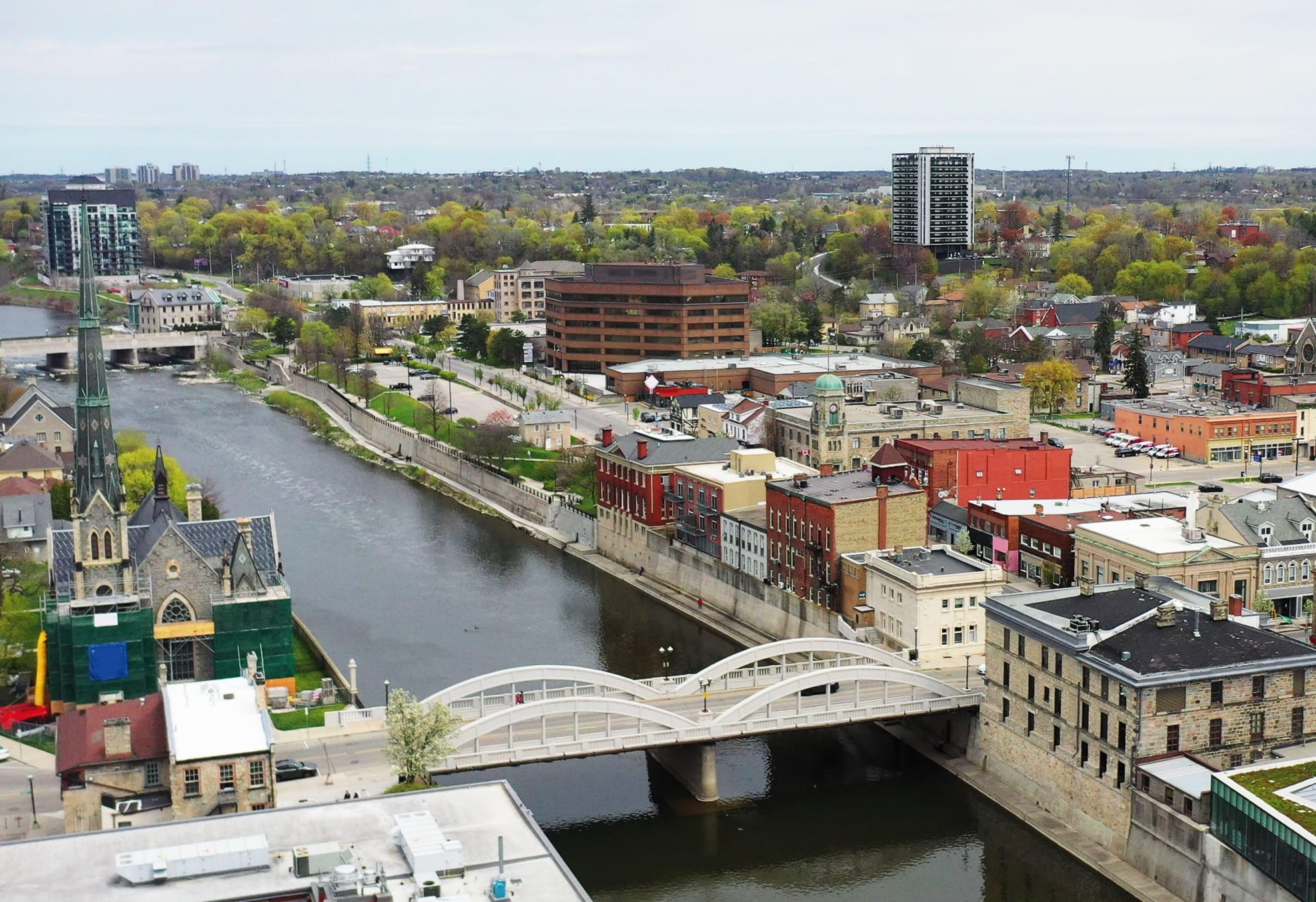
An overview of Downtown Galt containing a rich collection of buildings, streetscapes, and landscape features that together tell the story of Galt’s beginnings on the banks of the Grand River in the nineteenth century. These features, the stories they convey and the sense of place that they create, are valued by the local community and are of significant cultural heritage value as a distinct area.

Get Involved!

Community engagement is integral to the success of a Heritage Conservation District (HCD) Plan. People who live and work in the area can identify important characteristics of the area and elements that should be retained and celebrated. Consultation also allows for members of the community to express what new development within the District should look like and how best to implement recommended policies and guidelines. The Plan’s engagement program encouraged active discussions with community members and property owners and provided opportunities to participate in the process and provide comments and feedback.

For inquires about the Galt Core HCD Project, please send them to heritageinfo@cambridge.ca.

Additionally, a Question and Answer section can also be found in the Detailed FAQ at the end of the page :)

  • Community Public Open House

    ⌚Mon Dec 8, 2025 4:00 - 7:00 P.M.

    📍Bowman Room, City Hall

    50 Dickson Street, Cambridge, ON, Canada

    Details

    On November 25, a Final Draft of the Galt Core HCD Plan will be presented to Council to begin the comment phase.

    This December 8, 2025 Open House is a drop-in session for the public to freely speak with the consulting team and to present their comments and questions about the draft HCD Plan. No appointment or prior booking is needed.

Council Calendar

Please check the Council agenda to review the date and time details through here. A presentation by staff will also be available online at this link prior to the meeting. Copies of the plan and the staff report will be available on the City of Cambridge Council Calendar where meetings are posted and agenda materials can be found.

Project Background

There are two phases; The Heritage Conservation Study then the Heritage Conservation Plan.

  • Study Phase

    The first is a heritage conservation district study phase which examines the history and character of the area and its buildings and structures. The study makes recommendations as to whether the area should be designated as a district and what its boundaries should be.
  • Plan Phase

    If the study recommends designating the area as a district, the second step is a heritage conservation district plan. The plan is developed, in consultation with the local community, and includes policies policies for conserving and enhancing the district's character.


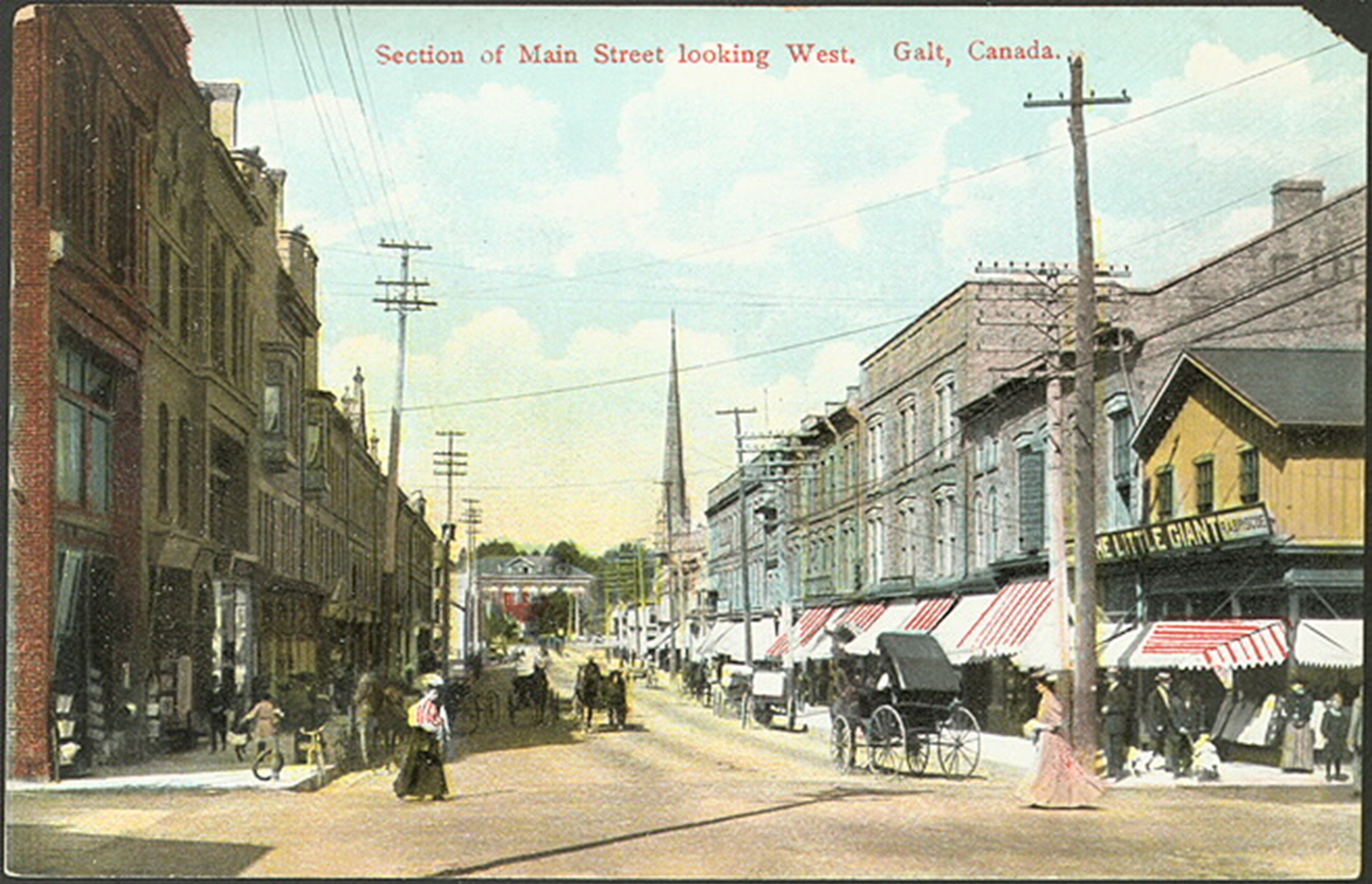
Main Streets looking west 1910 (Toronto Public Library)

Main Streets looking west 1910 (Toronto Public Library)

Common FAQs


An HCD is a geographically defined area within a municipality that is noted for its distinct heritage character.

An HCD may be defined by neighbourhoods or other locations with distinct features, styles, themes, or characteristics. HCDs can include buildings, trees, roads, landscapes and other elements that contribute to their unique character.

Under Part V of the Ontario Heritage Act, municipalities can protect districts by designating character-defining elements and their public realm, providing detailed guidance for redevelopment that occurs over time.


The purpose of designation is to guide physical change over time so that it protects heritage elements and character.

Designation recognizes and reinforces the community value of heritage properties, provides protection against inappropriate changes to heritage properties, controls demolition, and gives heritage property owners access to limited financial assistance for maintenance and restoration works.

The purpose of heritage designation is not to prevent changes to the property, but to manage it so that the attributes and characteristics which make the property special are retained, celebrated, and respected. This is to ensure that they complement, rather than compromise, the integrity of the property’s cultural heritage value.

Designation can apply to both individual properties or districts.


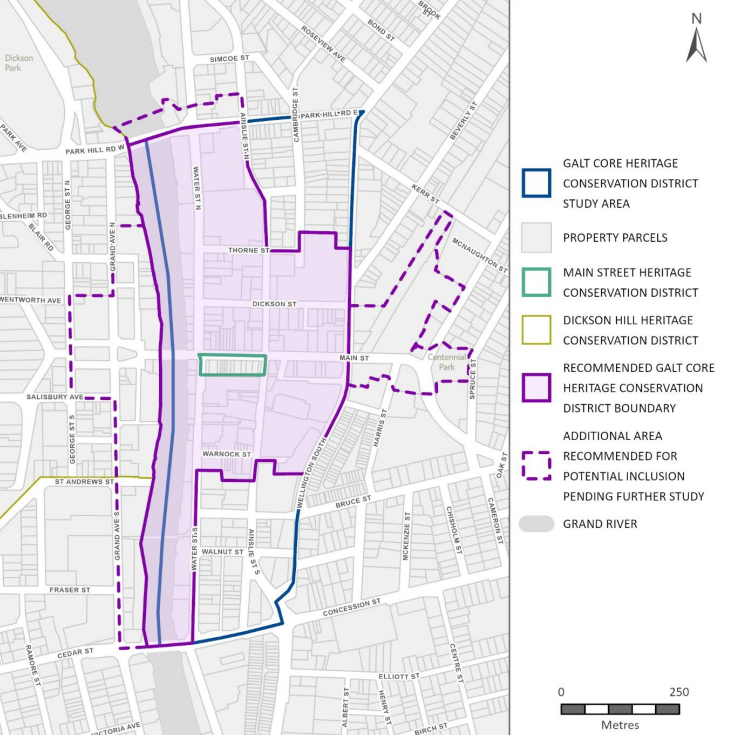
The boundaries for the plan were determined based on historical mapping and areas of concentration of historic building stock found from our HCD Study in 2021 as well as further and refined research performed between 2023 - 2025. The study area also incorporates residential, commercial, and industrial portions.


Several academic studies have shown that heritage designation is positively correlated with improvements in residential property values (see Robert Shipley, 2000; Paul Shaker, 2019; and Rebecca Correia et al., 2023)

Heritage Conservation Districts help to guide the type of infill, urban design, beautification, alterations, and conservation that should occur in the District. Change is not regulated and guided through the Heritage Permit process, but not prohibited. A Heritage Conservation District in the Galt Core will ensure that future developments and renovation in the boundary complement the District's character. The HCD can also generate tourism and enhance Galt's identity, pride, and civic involvement.

Finally, all property owners of designated properties within an HCD are eligible for the City's Designated Heritage Property Grant Program which enables the reimbursement of monies spent on property upkeep or restoration work up to a maximum of $5,000 per calendar year. The application form can be accessed online and is available here.

Project Background Details

The Study was initiated in January 2021 to assess the defined study area in detail and to determine if it merits conservation as a HCD, through designation under Part V of the Ontario Heritage Act (OHA).

The final Study report was completed in June 2021 and recommended that the City of Cambridge proceed to prepare an HCD Plan in Galt’s downtown core.

On July 27th, 2021, Cambridge City Council recommended that an HCD Plan be prepared for lands located within the boundary. The HCD plan was finalized in January 30, 2023 with a Public Information Centre #3 on February 15, 2023.

Working from the results of the HCD Study, and with the District boundary as approved by Council, this HCD. Plan was prepared in accordance with the Ontario Heritage Act and the Ontario Heritage Tool Kit - Heritage Conservation Districts (Ministry of Citizenship and Multiculturalism, 2025).

The development of the Plan included the identification of contributing and non-contributing properties, and outlining objectives, policies, and design guidelines that support the conservation and enhancement of the District.

These were developed and refined in collaboration with City staff and the Project Steering Committee and through public and stakeholder engagement. The Plan was also developed in consultation with project teams working on the concurrent Growth and Intensification Study, to ensure that the studies would inform and complement each other.

However, during the final phase of the plan, changes were made to the Ontario Heritage Act under the More Homes Built Faster Act, 2022 (Bill 23) resulting in new requirements for HCDs. Bill 23 came into effect starting on January 1, 2023. Shortly thereafter, the project was paused to consider modifications to the district boundary and ultimately re-initiated in Q2 2025.

An important change was the Ontario Heritage Act Regulation 9/06 (O. Reg 9/06) Criteria for Determining Cultural Heritage Value or Interest require that at least 25% of the properties within an HCD must meet two or more criteria in the regulation in order to be designated, changing the methodology in evaluating HCDs.

As the majority of the Galt Core HCD Study and Plan work occurred prior to January 1, 2023, this Plan has been supplemented with an updated evaluation table documenting how the District meets criteria under O. Reg 9/06 within the Volume 2 of the HCD Plan June 2023.

Statements of contribution for individual properties are available upon request from City staff where Statements of contribution provide a rationale for how each contributing property demonstrates or supports the cultural heritage values and integrity of the HCD. They also help to determine how the policies and guidelines of the HCD Plan apply to each contributing property.

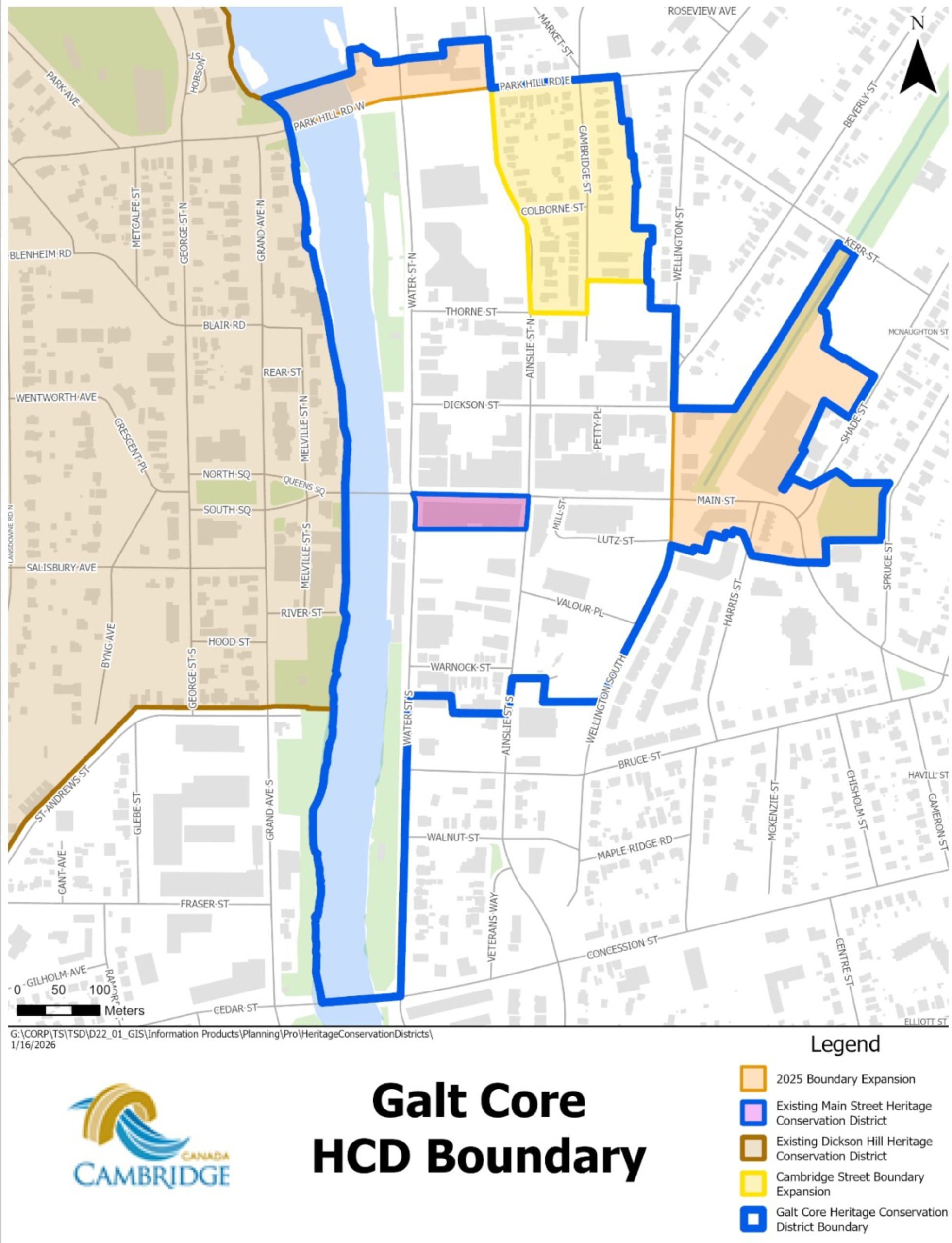
In Spring 2025, the project was re-initiated and opportunities to expand the boundary were studied; the area north of Park Hill Road and the area east of Wellington Street. It was determined that these areas warrant inclusion in the final HCD boundary and endorsed by council to be included amidst the development of the Plan phase.

Based upon best practices in heritage conservation designation and assessment of the areas surrounding the HCD boundary, the consultants recommend adding several properties and landscape features along Water Street North and Park Hill Road East and along Main Street east of Wellington Street. A total of nine (9) properties are recommended to be added to the boundary including Centennial Park. Seven (7) of these properties were found to hold significant cultural heritage value to warrant inclusion into the HCD boundary area as contributing properties. There are two (2) properties proposed to be included in the expanded boundary as non-contributing properties. The modified boundary comprises a total of 146 individual property parcels. The draft plan and guidelines has been updated to include these proposed modifications to the boundary.


Galt Core November 2025 with Expanded Area Changes

Galt Core Plan with 2025 Expanded Boundary Changes


Current Galt Core HCD Plan 2025 Documents

Got Questions and Comments?


Archive and Background

Below are the past results of Public Engagement Meetings. The same information can be found in the Galt Core HCD Study and Plan respectively. More historic images can also be found in the Important Documents above.


  • Galt City Centre has been identified as an area with heritage significance within the City of Cambridge since at least the 1980s. In 1985, the Main Street Heritage Conservation District was designated, recognizing the significance of a block of commercial buildings on the south side of Main Street between Ainslie and Water Streets.
  • In 2008, The City of Cambridge Heritage Master Plan recognized Galt City Centre as a heritage “character area” and recommended further evaluation
  • In 2013, the City adopted Downtown Urban Design Guidelines which recommended that the existing Main Street Heritage Conservation district be expanded to encompass a greater area. Main Street Urban Design Guidelines that recognized the special heritage character of Galt City Centre were also adopted at this time.
  • Through 2018, consultation was conducted to determine public support of a potential Heritage Conservation District Study for Galt City Centre and to establish study area boundaries. This consultation indicated public support for a Heritage Conservation District Study
  • On October 9, 2018 The City of Cambridge Planning and Development Committee approved the commencement of the Galt Heritage Conservation District Study in 2020 subject to future capital budget approval
  • On 28 July 2020, Cambridge City Council directed staff to begin the Galt Core Heritage Conservation District Study

The Galt Core HCD Study Area is strongly defined by the Grand River. For thousands of years, the Grand River and its tributaries, including Mill Creek, influenced where and how people travelled, where people settled, and where people farmed or developed industries. Lots were laid out perpendicular to the river, in an east-west direction in this area, as opposed to a north-south axis throughout the rest of the Township. The point where Mill Creek meets the Grand River was selected by William Dickson and Absalom Shade as an ideal location for settlement in 1816. Nestled in the river valley with relict shorelines to the east and west, the early settlement of Shade’s Mills/Galt quickly grew as a town site, supporting the early settlers attracted to the fertile soil in the surrounding countryside. Indeed, the community became a regional hub, providing commercial and civic/institutional services to residents and visitors alike.

The Grand River and the construction of the Galt Dam and Mill Race Canal in 1837 provided waterpower for anticipated factories, setting the stage for Galt’s growth and economic development in subsequent decades. Galt quickly established itself as an industrial town with a diverse array of industry, including textile factories, edge tool works, flouring mills, foundries, tanneries, and other varied sites. Besides being known as “The Granite City” for its stone buildings (Dilse 1981), it also became known as the “Manchester of Canada.” The town’s industrial might contributed to its economic growth and social development between the 1860s and the turn of the century. During this time, industry was especially concentrated on Water Street North and around the railway corridor adjacent to Mill Creek. Galt’s downtown core was always much more than an industrial centre, though. Indeed, it was a central location for social and cultural gatherings, for commerce, and for civic involvement, all of which fostered a bustling community which served both locals and the surrounding rural countryside. Galt continued to grow rapidly in all directions from its historical core well into the twentieth century.

While some key industrial facilities closed in the post-Second World War period, manufacturing operations continued to be the most important form of employment during that time. In particular, Galt’s textile industry remained an important sector within the Study Area. Overall, however, the postwar period marked the beginning of the decline of major industry within the Study Area boundary. Like elsewhere in Ontario, downtown factories were getting phased out and suburban factories emerged which could be served by both railways and transport trucks. Many industries decided to open or move operations north of the Study Area in proximity to Highway 401, which opened in 1960.

The City of Cambridge was formed in 1973 through the amalgamation of Galt, Hespeler, Preston, Blair, and parts of the Townships of North Dumfries and Waterloo. Galt had always been a civic hub and that continued when its downtown was chosen as the location of Cambridge’s new municipal offices. The former City of Galt, like much of the rest of Canada, experienced economic stagnation, and industrial decline in the 1970s and 1980s. As industry left the area, many industrial buildings were demolished but others were repurposed for other uses. The historical core of Galt still features a number of landmark civic and institutional buildings, as well as commercial and residential structures that are directly associated with that industrial past.

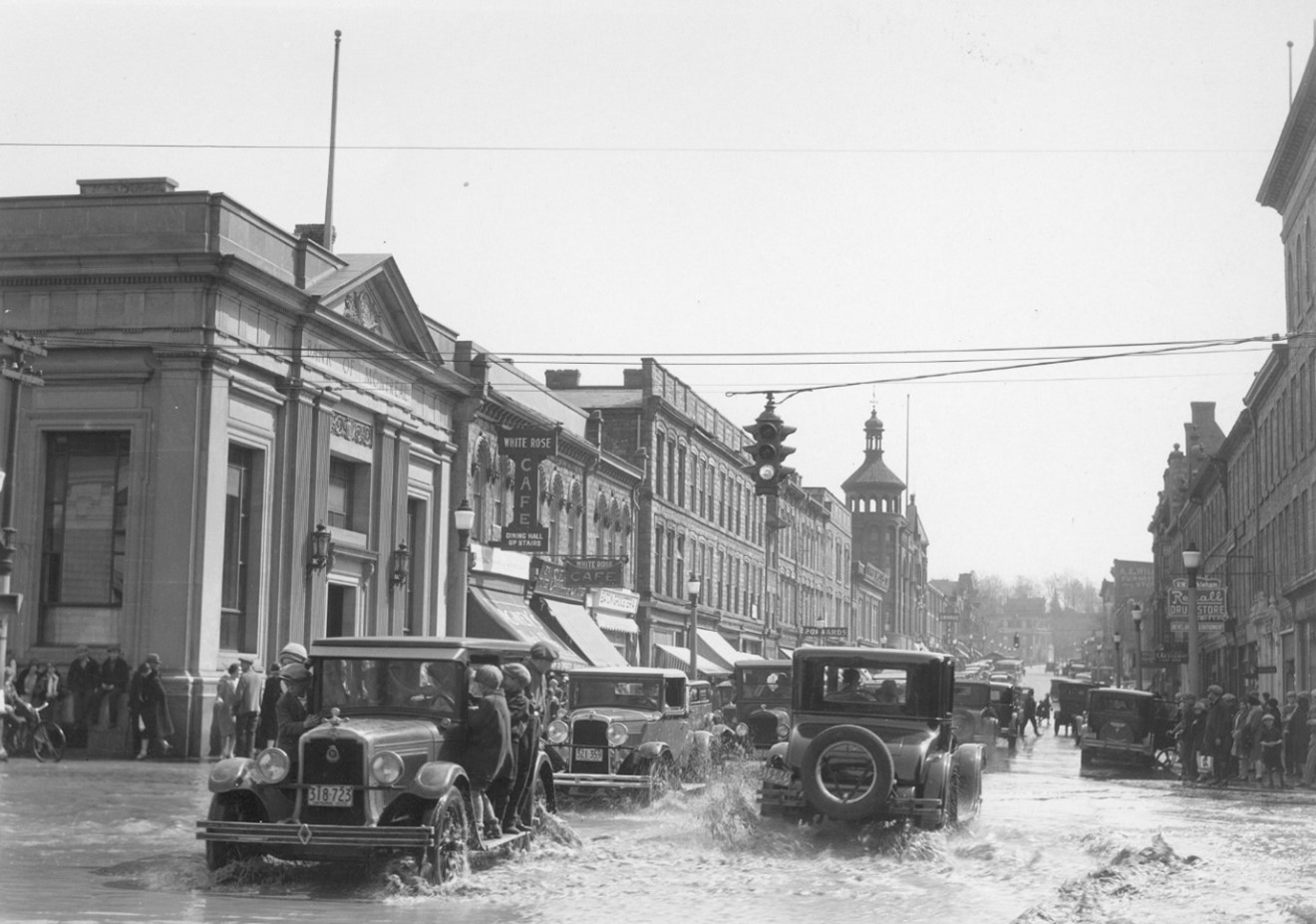
Through it all, the Galt Core HCD. Study Area continued to be defined by the Grand River. Following a massive flood in 1974, many riverside industrial buildings were demolished and replaced by concrete walls, earth berms, and other flood protection measures. Mill Race Park was completed on these former industrial lands, on the site of the original Mill Race Canal. Today, Mill Race Park and the Grand River forms the backdrop to many social events and gatherings in Galt. The Park is also the site of the official Grand River Canadian Heritage River Designation plaque.


Flooding in Downtown Galt 1929 (City of Cambridge)

Flooding in Downtown Galt 1929 (City of Cambridge)


Study Phase 2021

Public Information Centre #1, February 8, 2021.

All property owners within the study area were notified of the P.I.C. by mail and invited to participate. Key stakeholders, and all those who participated in previous public consultation regarding a Galt Core HCD Study in 2018 were notified by mail where a mailing address was available, and by e-mail where an e-mail address had been provided.

The session was also advertised on the City’s project webpage and in a newspaper having general circulation within the Municipality (The Cambridge Times). Participants included residents and property owners within the Study Area, as well as residents and interested parties from other areas of the City and outside of Cambridge.

  • Introduction to H.C.D.s

    The first component of the session focused on providing the public with an understanding of how an HCD operates in practice through the application of District guidelines and a permitting system.

  • Heritage Character

    The second component of the session was held as smaller breakout groups facilitated by a consultant team member and a City Staff member. The discussion focused on: gaining insight about the community’s character by identifying special places; buildings and streetscape which do not reflect Galt’s character, charm, and sense of place; as well as opportunities to strengthen Galt’s heritage character.

  • Boundary Exploration

    The groups then examined the Study Area boundary to define the places that tell the story of Galt’s past and give it a unique character and the places that are essential to manage appropriately into the future and as the community changes through intensification.

Introduction to HCDs

Participants noted the following “special places” within and adjacent to the Study Area:


  • Mill Race Park and Amphitheatre
  • The Grand River – this is a heritage designated River; a participant noted everything on the river should be protected. Area south of the Park Hill bridge.
  • Waterfront between all three bridges
  • The complex/area/square defined by the Idea Exchange/Old Post Office, rears of buildings fronting on Main between Water and Highway 24
  • Queen Square buildings and churches
  • Main Street buildings; Stone buildings on north side of Main Street
  • The rear side of Main Street [Imperial Lane] and working-class side of things, including the views and vistas
  • South of Main fronting on Water St. S. and backing on the river
  • Ainslie Street buildings from Dickson to the Armory
  • Warnock Street worker’s houses.
  • Centennial Park because it frames the east side of Main Street. Was “High View Park.”
  • Everything within several hundred feet of Water and Main and Ainslie and Main are important.
  • The general ‘low-rise’ built form
  • Wellington Street
  • Cottages along Water Street
  • Pockets along Cambridge Street, including the former town hall, stone and brick mix along Cambridge Street


  • A house on Water Street – was previously a hair salon and synagogue
  • Bank of Commerce (Southeast corner Main and Water)
  • Black Badger
  • Branch 121
  • Carnegie Library
  • Churches
  • Historic City Hall Clock Tower
  • Old Galt Library
  • Old Post Office
  • School of Architecture
  • Scott Building on Water St. S.
  • Stone and brick buildings
  • Stone Cottage on Water St. S., backing onto the river
  • The Armoury Building
  • The building at the corner of Main and Water (northeast corner)
  • The Eatery and Art Gallery
  • The Farmers’ Market
  • Wesley United Church
  • Thyssen block representing the 1960s evolution of Galt, an example of “filling in” during post-war periods, emblematic of how Galt can grow while accommodating change


  • Mainstreet view shed
  • Views along the Grand River

Non-Character Elements within Galt

Participants noted the following buildings, streetscapes and characteristics which do not reflect Galt’s character, charm, and sense of place with discussion within and adjacent to the Study Area

  • The Giant Tiger, specifically the signage which detracts from the character
  • Development across from the Giant Tiger representative as out of context or unsympathetic
  • Scotiabank at northwest corner of Main and Ainslie
  • Subway restaurant
  • Shoppers Drug Mart sign and entrance to Galt Core
  • Food Basics grocery store
  • BMO building on north side of Main Street between Water and Ainslie
  • Bus terminal, problematic beside small cottages.
  • Vacant spots on river
  • BF Goodrich
  • Areas behind bus terminal
  • Cambridge Place
  • 151 Main Street

Enhancing Character

Participants then discussed the following opportunities to enhance the character of the Study Area:

  • Parking lot between L.A. Franks
  • Levee brought out flat to the street, could have field on top like Quebec City with parking underneath. It would be non-intrusive.
  • Galt Amphitheatre and properties along there. Water access is important. It is protected already but needs to be strengthened.
  • The most important thing is the views.
  • The church steeples are really important.
  • There should be opportunities for them to access funds.
  • The water is important, including the views and vistas. West Galt is sitting in a little bowl is very important for views and vistas.
  • Could do something like downtown Guelph where nothing obstructs the view of Church of our lady. Nothing should obstruct a steeple.
  • Areas for potential include Dickson Bowl, next to Armoury
  • Cambridge Place could be interesting.
  • Complements the idea of underground parking with greenspace. We want to encourage people to want to be there

Boundary Discussion

In one breakout group, community members drew boundaries which expanded the Study Area boundary to include Grand Avenue or George Street west of the Grand River. The second breakout group did not complete the boundary discussion, but it was noted that the dam north of the Park Hill Road Bridge could be included. The third breakout group drew a boundary which expanded the Study Area eastward to include Kerr Street, Shade Street and Cameron Street.

Among conversations that occurred relating to the boundary mapping exercises, participants generally
discussed other ideas about character and conservation objectives, including;

  • The need for clear vision setting for the growth that is coming and integral to Galt’s future.
  • Is height and materiality necessarily prescriptive, i.e., no tall buildings and no steel?
  • Emphasis on need for consistent, sympathetic, and respectful design principles
  • Height prescription is key to heritage conservation in Galt.

Public Presentation Meeting #2, June 10, 2021

The session was open to all business owners, property owners, residents, agencies, developers, and any other interested parties. All property owners within the study area, and recommended HCD boundary, were notified of the PIC by mail and invited to participate. Key stakeholders, and all those who participated in previous public consultation regarding a Galt Core HCD Study in 2018 were notified by mail where a mailing address was available, and by e-mail where an e-mail address had been provided.

The session was also advertised on the City’s project webpage and in a newspaper having general circulation within the Municipality (The Cambridge Times). Participants included residents and property owners within the Study Area, as well as residents and interested parties from other areas of the City and outside of Cambridge.

The session began with a power point presentation by the consultant team addressing the following items:

  • Overview of engagement to date, including informal sessions;
  • Summary of significant time periods and themes;
  • Summary of heritage evaluation results;
  • Key excerpts from Statement of Significance; and
  • The proposed HCD boundary.

A short question and answer session followed, where the consultant team discussed curated questions based on feedback received to date on the recommended boundary, questions from other sessions, and questions directly posed to the City throughout the process.

Following this, the session format shifted to three breakout rooms to allow attendees more time to participate in a guided discussion. During the breakout sessions, participants provided feedback on the HCD boundary, key heritage values described, potential heritage attributes, and about consolidation of the Main Street HCD into the proposed Galt Core HCD and about extending the boundary into portions of the Dickson Hill HCD.

Property Owners Sessions

Owners were invited to participate in one of two focus group workshops. In total, nineteen property owners attended the sessions, representing approximately 8% of the total property owners. The objectives of the meeting were to share information about HCDs, introduce the study to property owners and understand their relationship to the area. To help property owners better understand the implications of an HCD Plan, the City’s Project Manager presented on the impacts of an HCD. Plan including how it influences development, how the permit process works and potential impacts on property values. The presentation was followed by a discussion between the property owners, the consultant team and City staff. Generally, property owners identified heritage as an asset to the downtown core and support heritage conservation. There was concern expressed about how an HCD. would be implemented and enforced and that a prospective Plan would need to balance conservation with a desire to animate and revitalize the downtown through intensification and investment. A desire for a streamlined development process was also identified as a priority and critical for successful implementation

Community Update Sessions

Members of the public were requested to indicate interest in attending these future update sessions to the City’s project manager at the First Public Information Centre and on the project webpage. Notice was provided by e-mail to a list of interested parties. These sessions were organized to receive public feedback on the area history and thematic historical framework. Ten members of the public attended the meeting on April 14 and eight members of the public attended on April 20. At both sessions, the City’s Project Manager presented a summary of the consultant teams initial findings on the history of the area as presented to the City in Technical Memorandum #1. The presentation was followed by discussions about the general area history, targeted questions, identified themes and boundary.

Direct Correspondence with City's Project Manager

The City’s Project Manager was responsible for inviting community members to participate in engagement events. The following table provides the number of letters and emails sent, which events were advertised in the newspaper and the number of attendees (Table 1). The City also contacted the Six Nations at Oshweken, ON and the Mississaugas of the New Credit at Hagersville, ON. These contacts were made by email on December 23, 2020, and January 27, 2021.

Correspondence and Attendance Numbers

EventLettersEmailsNewspaperAttendance
Study: Commencement25346NoN/A
PIC #125348Cambridge Times23
PIC #229590No25
Property Owner Sessions089No10 and 8
Community Updates

Through the course of the project, the City Project manager received e-mails and phone calls from approximately 20 community members. The following table provides a summary of the range of these comments.

Comments Received from Members of the Public

CategoriesDescription
Highly SupportiveReceived several highly supportive messages. The authors question whether the study goes far enough to protect Galt Core’s heritage, e.g., questioning the decision not to put in place an interim control by-law. They also wanted to be assured that the heights study was on hold until the HCD project had been completed
CuriousCommunity members have messaged asking about what an HCD study is and what it means for their properties. Questions related to how they can research their own properties. They value Galt’s heritage, but are unsure of what it would mean for them personally to be designated.
ApprehensiveThis category involves property owners who may have plans in place to redevelop properties and are concerned that an HCD would cause difficulties.
OpponentsReceived several messages indicating that the authors are not supportive of a heritage conservation district or may be supportive of a district greatly reduced in size. These community members are concerned that an HCD would stifle growth in the downtown core. They are concerned that Galt is already struggling to attract investment and do not want to make it more difficult. They are not interested in the study or its process but would like to be kept informed when contributing and non-contributing properties are identified.

Municipal Heritage Advisory Commitee

Seven members of the Heritage Committee, City Staff, and the consultant team were present. The consultant team gave a presentation on the work completed to date and the emerging analysis from the history and evolution of the Study Area, the built form and landscape survey, and the character analysis. The Heritage Committee provided the consultant team with feedback about the following topics: the boundary of the Study Area as it relates to an understanding of downtown Galt; a secondary source document recommended for review; and managing change within the downtown to balance growth, intensification, density, and conservation. The consultant team also solicited information about the social aspects of Galt Core. The Heritage Committee provided several events and locations within Galt Core however there was also agreement that activity in Galt Core is significantly lacking.

Survey

The objective of this survey was to gather additional feedback from participants of the public information centre and those members of the community who were unable to attend. Eighty people (80) visited the site and twenty-three people responded to the survey. The survey questions covered the same topics as Public Information Centre #1 related to the area’s character and study area boundary. The results from the Survey and Public Information Centre #1 have been compiled and illustrated on a map of the Study Area.

Areas that reflect Galt’s historical character (Map 1) are shown in shades of green with the darker shade of green reflecting the areas that people have identified as reflecting Galt’s historical character.

Areas that detract from Galt’s historical character (Map 2) are shown in shades of orange with the darker shade reflecting areas that people have identified as detracting from Galt’s historical character. The results of the discussions and questions about boundary have been compiled with 22 distinct but similar boundaries (Map 3).

On this map, the darker the colour, the more people suggested that area’s inclusion within a prospective boundary. Several respondents suggested that boundaries should align with topographic points located at the height of the ridge of the Grand River valley.

Plan Phase 2023

Public Information Centre #1, January 26, 2022

The session was open to all business owners, property owners, residents, agencies, developers, and any other interested parties. All property owners within the study area were notified of the PIC. by mail and invited to participate.

Key stakeholders, and all those who participated in previous public consultation for the Galt Core HCD Study were notified by mail where a mailing address was available, and by e-mail where an e-mail address had been provided. The session was also advertised on the City’s project webpage, on the City’s Twitter page and in a newspaper having general circulation within the Municipality (The Cambridge Times).

  • H.C.D. Overview

    The first component of the session focused on providing the public with the following;

    • An overview of the HCD Study findings
    • The Council approved HCD Plan boundary
    • An overview of the HCD Plan process, including a draft identification of contributing and non-contributing properties
    • Presentation of draft objectives for the District.
    • Question and Answer session for participants to ask questions to the consultant team and City Staff.
  • Feedback and Insight

    The second component was held with breakout groups facilitated by a consultant team member and City staff member. The discussion focused on:

    • Gaining insight about the elements that should be retained and celebrated as intensification and growth comes to Galt Core;
    • Additional important characteristics or qualities that the consultant team should be aware of and manage as Galt Core continues to evolve;
    • How the community sees new development fitting into the HCD
    • What it should look like
  • Question & Answers Session

    The Question and answer session that followed the consultant team presentation focused on themes including

    • The Main Street HCD and potential future integration with the Galt Core HC.D;
    • The relationship between the HCD Plan and Height Guidelines Study;
    • Financial incentives for properties within the HCD boundaries;
    • If the mapping showing HCD boundaries will be available to the public after the meeting.


  • Views down and across Mill Race Park
  • Maintaining the rear of buildings along the Grand River. Any redevelopment should be thoughtfully designed to maintain riverscape and heritage character.
  • Provides space for events. Would like to see programmable space expanded.
  • Highlighting and celebrating trails that run down through Mill Race Park along the River
  • Participants noted the large grocery store could be a potential property for redevelopment but noted the importance of maintaining a grocery store downtown, the parking it provides, landscaping, and views to the Grand River


  • Main Street Bridge as a focal point.
  • Commercial buildings (i.e., banks) and landmark buildings are important to areas character •
  • Laneway enhancement to improve walkability and public realm.
  • Creatively using the streets (i.e., temporarily closing them and expanding restaurants, celebrations) and introducing art to facades and laneways.
  • Views and vistas are important (i.e., looking down Main Street to Queen’s Square and views in the opposite direction).
  • Need for green space.
  • Maintaining original facades and varied architectural styles.
  • Multi-functionality of Imperial Lane parking lot.
  • Concerns about the height of buildings to the west and east and their impact on views of buildings, landscaping and trees, as well as shadow concerns.


  • "Marrying” the old architecture with new architecture (i.e., New City Hall with Old City Hall good example).
  • Improve public realm through streetlighting, landscaping, improved walkability and accessibility, public space for events, and public art. Existing public space (i.e., City Hall) is important.
  • Churches are important identifying features


  • Redevelopment expected in this area with the introduction of a light rail system and lack of cohesive built form.
  • Armoury building should be maintained during redevelopment and new development around the Armoury should be sensitive to it (i.e., limited heights). Views of the armoury should be maintained.
  • Unique collection of residential buildings (i.e., Warnock Street, worker’s housing) that require strong policies for conservation and management.
  • Interpretive signage or other interpretive methods (i.e., QR codes on buildings) to provide additional understanding of area.
  • Need for additional green space.
  • Visually interesting area compared to many others.
  • Maintaining brick siding on buildings.
  • Views to the Grand River should be maintained.
  • Landreth Cottage should be protected.
  • Concerns over development in this area.
  • Maintain as public space.
  • Developing continual walkways along the River.

Participants noted the following in a discussion regarding new development in the H.C.D. Plan area, the elements they would like to see new development respond to or achieve, and what new development look likes to them:

  • Building heights need to be carefully considered. Concern with large buildings interrupting important views (i.e., Church spires)
  • Density should be added but needs to be compatible with current structures.
  • New development needs to also serve those living in the Downtown Core.
  • Grants and incentives to address the rear of buildings.
  • Imperial Lane parking lot is important.
  • Compatible scale, massing, and materials.
  • Signage guidelines.
  • New development should not try to mimic the old. Materials and designs should instead compliment area.
  • Salvaging materials from original building and incorporating into new development.

Following the Question and Answer session, participants were moved to smaller breakout tables and were given a map of the H.C.D. with six areas in the H.C.D. boundary highlighted.

Participants were asked to identify elements that should be retained and celebrated in each area, as well as important characteristics that have yet to be identified but that are important to manage as the Galt Core evolves. For each area, the participants noted the following:

  • Question #1: Of the unique elements identified in each character area, what elements do you think should be retained and celebrated as intensification and growth comes to the downtown area?
  • Question #2: Within each character area, are there other important characteristics or qualities that we haven’t discussed or noted that are important to be aware of and manage as the Downtown continues to grow and evolve? •
  • Question #3: How do you see new development fitting into the H.C.D. Plan area? What does new development look like to you, and what elements would you like to see new development respond to or achieve?
Galt Core HCD Plan Character Map

Galt HCD Character Map used during the breakout session to present each character area to participants

Public Information Centre #2, April 7, 2022

The session was open to all business owners, property owners, residents, agencies, developers, and any other interested parties. All property owners within the study area, and recommended H.C.D. boundary, were notified of the Community Workshop by mail and invited to participate.

Key stakeholders, and all those who participated in previous public consultation regarding the Galt Core HCD. Study were notified by mail where a mailing address was available, and by e-mail where an e-mail address had been provided. The session was also advertised on the City’s project webpage, on the City’s Twitter page and in a newspaper having general circulation within the Municipality (The Cambridge Times).

The consultants first gave a presentation that identified sample guidelines and policies recommended for inclusion into the Plan. It also identified legislative requirements of a heritage permitting process for HCDs, and profiled different ways that other municipalities have developed heritage permit processes for H.C.D.s. The presentation identified a three-stream heritage permit process that may be appropriate for implementation in the Galt Core HCD

The Community Workshop consisted of three components.

  • The first component was a Question and Answer session that responded to the consultant team’s presentation.
  • The second component focused on a discussion around the tools to support implementing the HCD Plan and the types of changes that may be considered appropriate in the Galt Core HCD
  • Lastly, the final component of the Community Workshop focused on discussion related to precedent examples from other jurisdictions that illustrate how additions and new development can be introduced into a historic urban context. The consultant team identified elements of each example and discussed successes of each, and drew comparisons to the areas or streetscapes in the Galt Core HCD area where the precedent shown might serve as a good reference point. Feedback on the examples was invited from attendees and notes of the discussion were recorded.


  • Component 1: Q & A Session

    The first component was a Q & A session that ranged from topics on building height, the building permit process, the HCD boundary, and conservation measures for contributing and non-contributing properties within the HCD. This also included the discussion of three questions that related to tools to support the implementation of the HCD Plan, changes that may be considered appropriate in the Galt Core, and proposed strategies for the implementation of the HCD Plan.

  • Component 2: Discussion of Tools

    The second component focused on a discussion around the tools to support implementing the H.C.D. Plan and the types of changes that may be considered appropriate in the Galt Core H.C.D.

  • Component 3: Precedent Example Discussion

    The final portion of the Community workshop focused on discussion related to precedent examples from other jurisdictions that illustrate how additions, infill and new development can be introduced into a historic urban context. The consultant team identified elements of each example and discussed successes of each, and drew comparisons to the areas or streetscapes in the Galt Core HCD area where the precedent shown might serve as a good reference point. Summary notes were taken using Miro.

Miro Board presenting a summary of the precedent example discussion

Miro Board presenting a summary of the precedent example discussion

Direct Correspondence with City's Project Manager

The City’s Project Manager was responsible for inviting community members to participate in engagement events. The following table provides the number of letters and emails sent, where events were advertised and the number of attendees

Correspondence and Attendance Numbers

EventNumber of Letters SentNumber of Emails sentWhere Advertised (Newspapers, social media)Number of Attendees

P.I.C. #1 (January 26, 2022)257134 Cambridge Times, City Website Page, City’s Twitter PageApproximately 35 (including 4 staff)
Community Workshop (April 7, 2022)700184Cambridge Times, City Website Page, City’s Twitter Page43 (including 12 staff and consultants)
Statutory Public Open House (virtual on February 15, 2023, in-person on March 9, 2023)700184Cambridge Today, The Waterloo Record, City Website Page, City’s Twitter Page62 (including 7 staff and consultants)

Through the course of the project, the City Project manager received three (3) e-mails from community members about the project. Email correspondence was also received from the Grand River Conservation Authority (G.R.C.A.), inquiring about permits that may be required for undertakings that the G.R.C.A. may implement in relation to flood control infrastructure.The following table provides a summary of each email.

CategoriesDescription
SupportiveThe author of the email appears to be in strong favour of an HCD in Galt Core. The author argues for the maintenance of the “classic” downtown look by ensuring new development contributes to this look. Concern is raised over modern, “steel and glass” additions that do not fit with the older architectural styles.
ApprehensiveThe author of this email supports the HCD. in Galt Core, however, raises concerns over the treatment of the Main Street H.C.D. and Blair Village HCD. The author notes that little effort has been made to respect the H.C.D. designations, and is apprehensive that an HCD. Plan within the Galt Core will be followed if implemented based on current examples in the City’s other HCDs
OpponentsThe author of the email is not supportive of a heritage conservation district as they are concerned the tool is not appropriate to manage the evolving dynamics of downtown. Concern is raised over the size of the H.C.D., particularly the inclusion of the area with Food Basics and the bus station, and notes the large size may dilute funding and administration capabilities. The author also notes concern over the impact of restrictions placed on property owners within the H.C.D. to develop their property.

Online Engagement (May 1, 2022 - May, 30, 2022)

The objective of this survey was to gather additional feedback from community members. The 12 survey questions captured feedback on if respondents live or own property within the HCD boundary; activities that should and should not be exempt from heritage permit applications; who should be responsible for reviewing heritage permit applications; feedback regarding activities that should require a full heritage permit application; preferences for types of heritage permitting systems implemented in the HCD.; and an opportunity for respondents to suggest additional tools or resources that would be helpful to support the implementation of the HCD.

There was a total number of 77 survey responses. Of the 77 responses, 72.7% do not live or own property within the H.C.D. boundary.


Survey respondents were asked to share preferences about a variety of activities (i.e., interior renovation work, installing utilities, installing exterior lights, etc.) to be exempt from heritage permits.

  • General Findings:
    The majority of survey respondents selected that the activities listed should not require a heritage permit.
  • Mixed Results:
    • Re-painting: 47 respondents said it should not require a permit; 30 said it should.
    • Installation of exterior lights: 44 respondents said it should not require a permit; 33 said it should.
  • Greatest Difference in Responses:
    • Installing utilities: 67 said it should not require a permit; 10 said it should.
    • Temporary or seasonal installations: 69 said it should not require a permit; 8 said it should.

Interpretation:
Generally, what can be gleaned from these results is that those activities with the greatest visual impact to the area’s public-facing appearance such as re-painting or exterior lights resulted in more mixed responses. Activities with less permanent or visual impacts, such as installing utilities, received greater support from survey respondents for not requiring a permit.


Survey respondents were asked to list activities that they thought were so routine or low impact that they should be exempt from a heritage permit.

  • Overall Response:
    The majority of survey respondents had no suggestion for activities that should be exempt from heritage permits.
  • Opposing Views:
    • Six respondents opposed any further restrictions through heritage permit.
    • Four respondents were in favour of strict regulations with the majority of work within the HCD requiring a permit.
  • Suggestions from Other Respondents:
    • Landscaping
    • Accessibility upgrades
    • Roofing upgrades

Survey respondents were also asked about specific activities (i.e., adding ramps, repaving existing parking areas, etc.) and whether they should be exempt from a heritage permit.
The majority of respondents selected that the various activities should not require a heritage permit.


Survey respondents were given a list of activities and asked whether heritage permits should be reviewed by:

  • City Staff
  • The Municipal Heritage Advisory Committee (MHAC)
  • Approved by Council
  • Or not subject to any review prior to proceeding

Respondents were asked to comment on which permit applications should be delegated to staff for review and approval and which should not require review by MHAC and/or Council.

Findings:

  • The responses varied regarding permit review requirements depending on the proposed activity.
    • Activities with greater visual impact on a property’s heritage character such as additions of new dormers, replacement of porches, or alterations to architectural features—should be reviewed by MHAC and Council.
    • Interventions with lower impact on heritage qualities such as window replacement or building a secondary structure/garage not visible from the street—should be reviewed by Staff.


Survey respondents were asked if they believe any other types of activities or changes should require a full heritage permit with review and approval by MHAC and Council.

  • General Themes from Written Responses:
    • Public realm and landscaping activities
    • Building-specific measures (i.e., exterior renovations, recladding)
    • Skylines and views
    • Archaeological potential

A number of respondents noted in their responses that they were opposed to the HCD.Plan as well as additional restrictions.


The following questions revealed that the majority of survey respondents (56/77) would prefer a three-stream heritage permit system that:

  • Prioritizes major activities requiring heritage permits to be reviewed and approved by MHAC and Council
  • Enables staff to review and approve more minor activities

Additional Findings:

  • 51/77 respondents felt that staff should work with property owners and be delegated authority to review and approve less intrusive activities.
  • Respondents were split on the usefulness of a specialized H.C.D. advisory committee:
    • 38 respondents said it should not be created
    • 39 respondents said it would be useful

Survey respondents were asked if there were any tools or resources for property owners and/or community members that would be helpful in supporting the implementation of the HCD

  • Key Findings:
    Respondents expressed a desire for:
    • Clear guidelines for what work is permitted
    • Support from city staff and heritage experts throughout the permit process and with proposed alterations
    • An easy-to-understand, step-by-step process for obtaining heritage permits
    • Guidance on contractors specializing in heritage conservation work

Additionally, respondents noted a desire to have people well versed in heritage conservation within the HCD represented on:

  • Council
  • The Heritage Advisory Council
  • City planning staff

Planning - Statutory Public Open House

A statutory public open house was held virtually on February 15, 2023 and in-person on March 9, 2023 to present the results of the HCD Plan Phase to date. A list of contributing and noncontributing properties was available at these meetings. Members of the public had the opportunity to participate in facilitated discussions related to:

  • Public realm policies and guidelines;
  • Policies and guidelines for contributing and non-contributing properties;
  • Understanding surrounding context;
  • The heritage permit process; and
  • Financial incentives.

As part of these engagement sessions, participants had the opportunity to ask clarifying questions about the HCD process, seeking to understand what this planning framework would mean for property owners, what kinds of changes may or may not be allowed, how the heritage permit system worked, and whether financial incentives for heritage properties were available for property owners.

Summaries of all consultation meetings are on file with the City of Cambridge


What is a Municipal Register of Cultural Heritage Properties?

Municipalities must keep a Register of Heritage Properties that are of cultural heritage value or interest: this is an official list of properties that have heritage value or character for the community. The Register (sometimes also referred to as Heritage Inventory) notes properties that are Listed (S.27, Part IV), in a District (S.41, Part V) and Designated (S.29, Part IV) under the Ontario Heritage Act. The City of Cambridge Heritage Register consists of nearly 1,150 properties. The Register has legal status and can provide limited protection to these heritage resources, as follows: