Review of the Municipal Register of Cultural Heritage Properties
The City of Cambridge is reviewing the Municipal Register of Cultural Heritage Properties which includes properties that are listed as cultural heritage resources or are designated under the Ontario Heritage Act. Heritage Staff welcome you as an owner of a property listed on the City’s Register of Cultural Heritage Properties to learn more about the review and the process for designation of cultural heritage properties under Part IV, Section 29 of the Ontario Heritage Act.
Reach out to Heritage Staff! We invite you to visit with us during regular business hours (8:30am - 4:30pm weekdays) at City Hall, 50 Dickson Street, Cambridge, ON to freely speak with Heritage Staff about any questions, concerns, or to receive guidance. All are welcome.
Contact: heritageinfo@cambridge.ca
Heritage staff can address and explain the implications of the Ontario Heritage Act (OHA), and discuss the effects and benefits of Heritage Designations of private properties. Come and meet the Heritage Staff team, and learn about:
- the different levels of heritage protection under the Ontario Heritage Act
- the municipal Heritage Register and what it means to be a listed property
- the heritage Designation process and how designation recognizes and reinforces the community value of heritage properties
- the heritage permit process for alterations, renovations, and upgrades of designated properties
- the benefits of heritage Designation including access to grants for heritage designated property owners
Heritage designation helps guide physical changes to properties while protecting their historic character. It reinforces community value, prevents inappropriate alterations, controls demolition, and offers limited financial support for upkeep. The goal is not to stop change, but to ensure it respects and preserves the property's unique heritage features.
- No cost to the owner.
- Regular maintenance is expected, but restoration is not required.
- Designation doesn’t affect insurance or prevent updates to mechanical/electrical systems.
- Owners retain full rights to sell or use the property as permitted by zoning.
- Public access is not required.
- Designation applies to the entire property, including structures and landscapes, but typically excludes interiors unless specified in the by-law.
Owners of designated heritage properties benefit through:
- More stable and resilient property values over time
- Strengthened community identity and public appreciation
- Conservation of neighbourhood heritage for future generations
- Expert guidance from Heritage Staff on conservation practices
- Recognition through a heritage plaque
- Access to financial support via the City’s Grant Program and the Waterloo Regional Heritage Foundation
Owners may make changes without heritage review unless the designation by-law identifies specific features as heritage attributes. Even then, alterations can be adapted to meet new needs while respecting the property's historic character.
Interior features are rarely designated. Exterior changes are allowed but should complement the property's architectural style. If heritage attributes are affected, a Heritage Permit Application is required, including architectural drawings and may also require a Cultural Heritage Impact Assessment (CHIA) by a qualified heritage professional. Heritage Staff can assist with the application and design process. There is no fee for the Heritage Permit.
If Council denies the proposed changes, owners may appeal to the Conservation Review Board.
Routine maintenance or repairs to features not listed as heritage attributes in the designation by-law typically do not require heritage approval. Designated property owners must meet the same basic standards as all property owners under municipal maintenance and occupancy by-laws.
Guiding principles for heritage conservation are informed by international charters and government policies. For best practices on sensitive alterations, refer to:
- Eight guiding principles for heritage conservation
- “Well Preserved” – the Ontario Heritage Trust’s Manual of Principles and Practice for Architectural Conservation
- Parks Canada’s Standards and Guidelines for the Conservation of Historic Places in Canada
Insurance premiums for older buildings may be higher due to outdated systems, but heritage designation itself does not affect insurance costs in Ontario. Designation does not prevent updates to mechanical or electrical systems.
If a designated building is damaged or destroyed, owners are not required to replicate lost heritage features. Replacement buildings may differ in design.
Premiums depend on the building’s age, condition, and specific features—not its designation. Owners who want original features covered must ensure their policy includes appropriate coverage.
For more details, visit Ontario’s Heritage Properties and Insurance page at https://www.ontario.ca/page/heritage-properties-and-insurance.
What is a Heritage Register?
Municipalities must keep a Register of Heritage Properties that are of cultural heritage value or interest: this is an official list of properties that have heritage value or character for the community. The Register (sometimes also referred to as Heritage Inventory) notes properties that are Listed (S.27, Part IV), in a District (S.41, Part V) and Designated (S.29, Part IV) under the Ontario Heritage Act. The City of Cambridge Heritage Register consists of nearly 1,150 properties. The Register has legal status and can provide limited protection to these heritage resources, in one of the following four ways:
Listed properties are protected against demolition or removal of buildings or structures on the property unless the owner gives Council at least 60 days notice in writing of the intent to demolish or remove the building or structure. Heritage staff and MHAC review the application, and make recommendation to Council for approval of demolition, or for Designation of the property.
Under Bill 23 (More Homes Built Faster Act) and subsequent Bill 200 (Homeowner Protection Act), all Listed properties in Ontario not designated before January 1, 2027, will lose their heritage protection under the OHA, and cannot be re-Listed for a minimum of five (5) years.
Easement agreements are voluntary legal agreements registered on title of the property and binding on future owners. Entering into an easement agreement assures owners that the heritage attributes will be protected in perpetuity, by setting out covenants for maintaining the property or specific heritage features. While it doesn't typically prohibit all changes, it requires the owner to get approval from Council for actions that could affect the heritage attributes and includes positive obligations like maintenance.
In some circumstances, easement agreements may be required in return for municipal planning approvals or exemptions.Municipalities undertake studies and develop plans to identify and protect boundaries that present a distinct heritage character. The adoption of an HCD Plan lists policies and guidelines aimed to guide future change. HCDs can be incorporated into the Official Plan (or secondary plans) to integrate heritage conservation into mainstream planning. HCDs vary in character and features and are usually of a complex urban nature.
Owners of property in an HCD (designated under S.41, Part V) must obtain Council approval for alterations, new construction or demolition.The highest level of heritage protection is Part IV (S.29) designation: Council passes by-laws designating individual properties to identify and protect elements of cultural heritage value or interest.
Heritage designation provides protection to a property, or to portions of a property’s exterior, interior, or landscape features. It is registered on title and binding on future owners. Owners of designated properties must obtain council’s approval for:
- Alterations affecting identified heritage attributes (exterior, interior, and/or landscaping)
- New construction or additions
- Demolitions and irreversible alterations
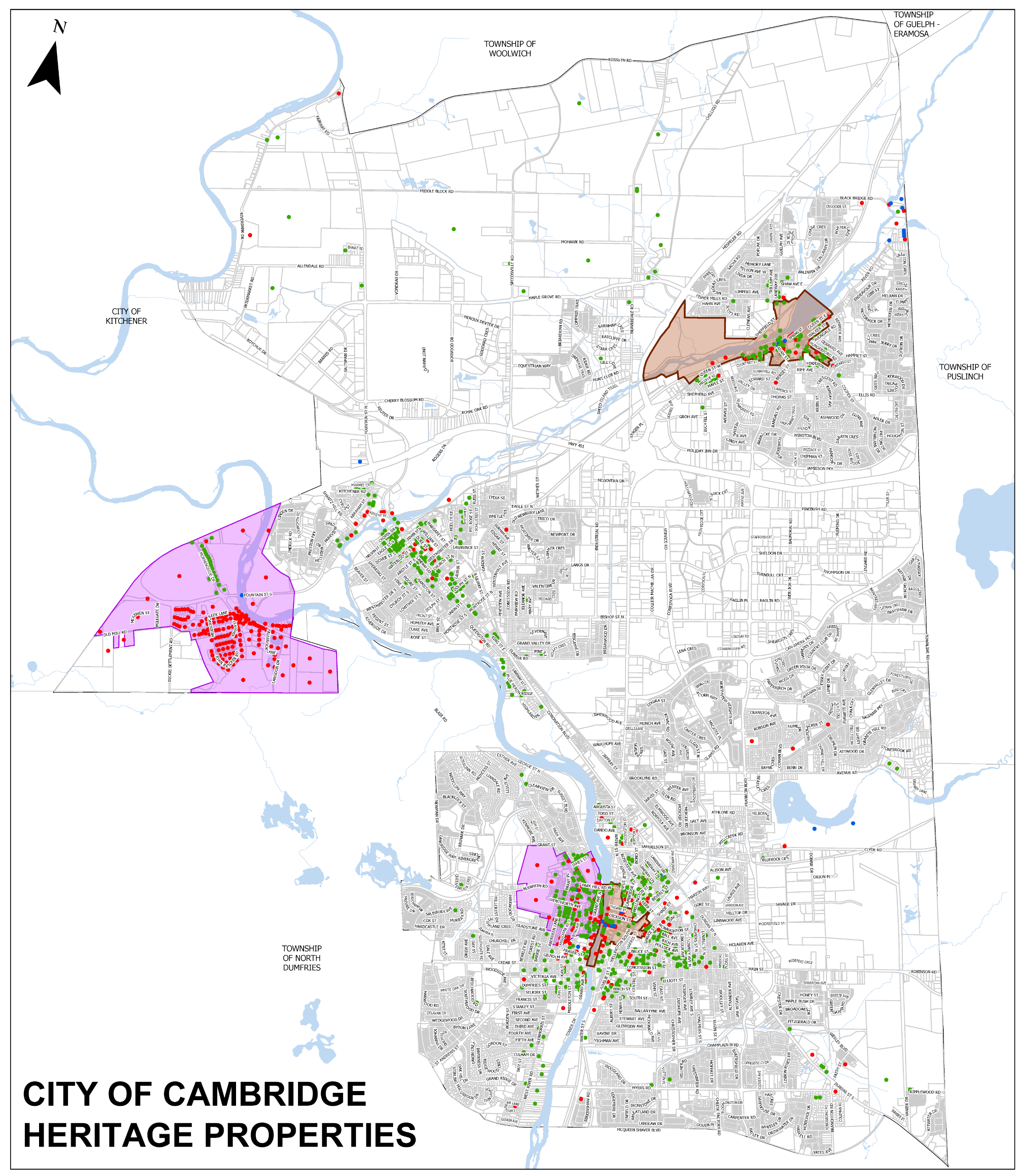
City of Cambridge - map of Listed and Designated properties on the Municipal Heritage Register